

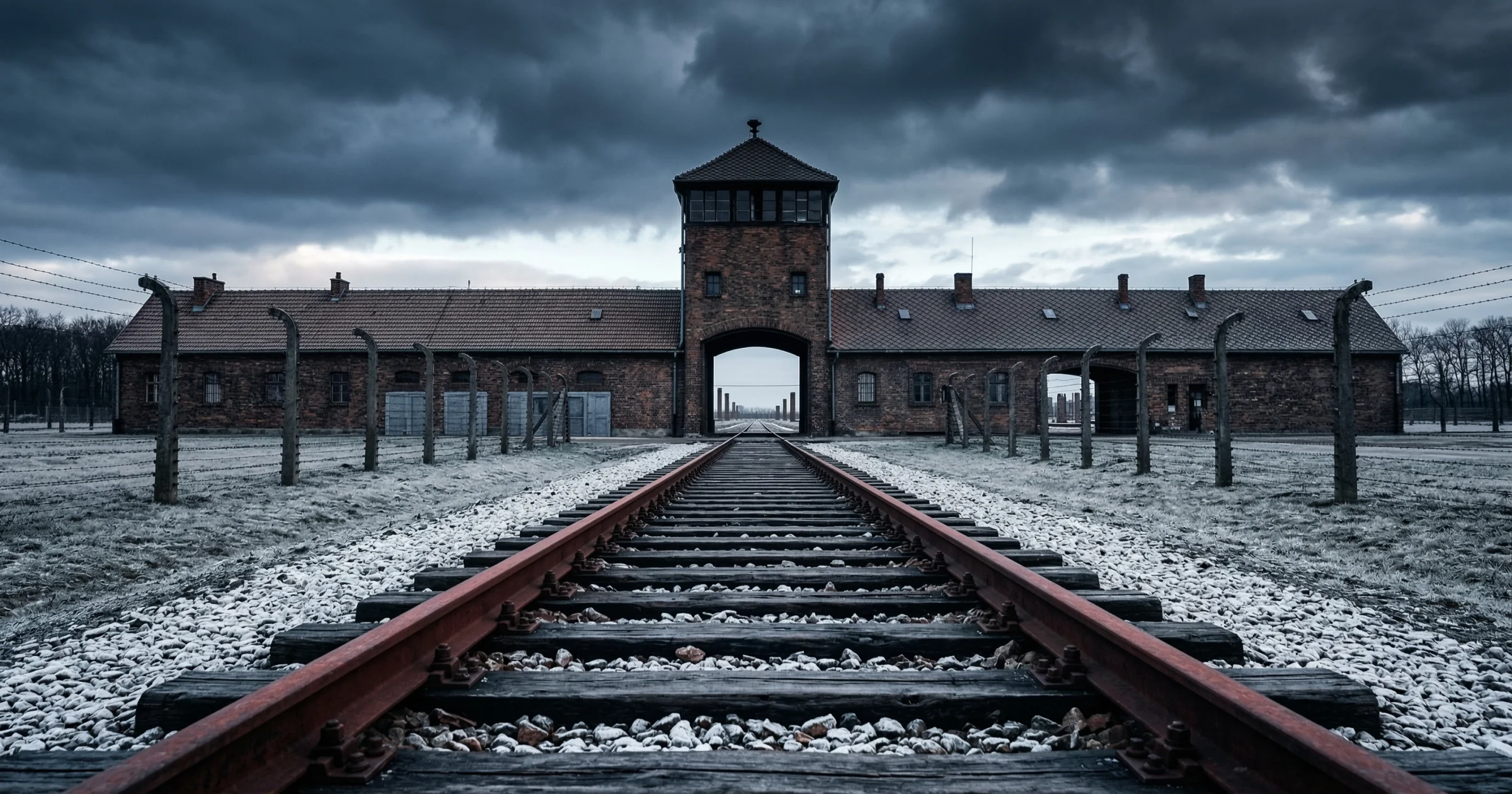
The Auschwitz-Birkenau Memorial and Museum covers two main sites — Auschwitz I and Auschwitz II-Birkenau — 3.5 km apart. A free shuttle bus runs between them every 10–15 minutes. Both open at 7:30 AM; closing time shifts by month, from 15:00 in December to 20:30 in summer. Entry to the grounds is free, but guided tours cost 150 PLN (~£29 / ~€35) per adult, booked at visit.auschwitz.org. UNESCO listed the memorial in 1979; over 2 million people visit each year.
- Auschwitz I and Auschwitz II-Birkenau are 3.5 km apart, connected by a free shuttle bus
- Both sites open at 7:30 AM; closing ranges from 15:00 (December) to 20:30 (summer)
- Entry to the grounds is free; guided tours cost 150 PLN (~£29 / ~€35) per adult
- Birkenau covers 175 hectares, dwarfing the smaller Auschwitz I site
- Over 2 million visitors per year; UNESCO World Heritage Site since 1979
The Auschwitz-Birkenau State Museum and Memorial: Scale and Significance
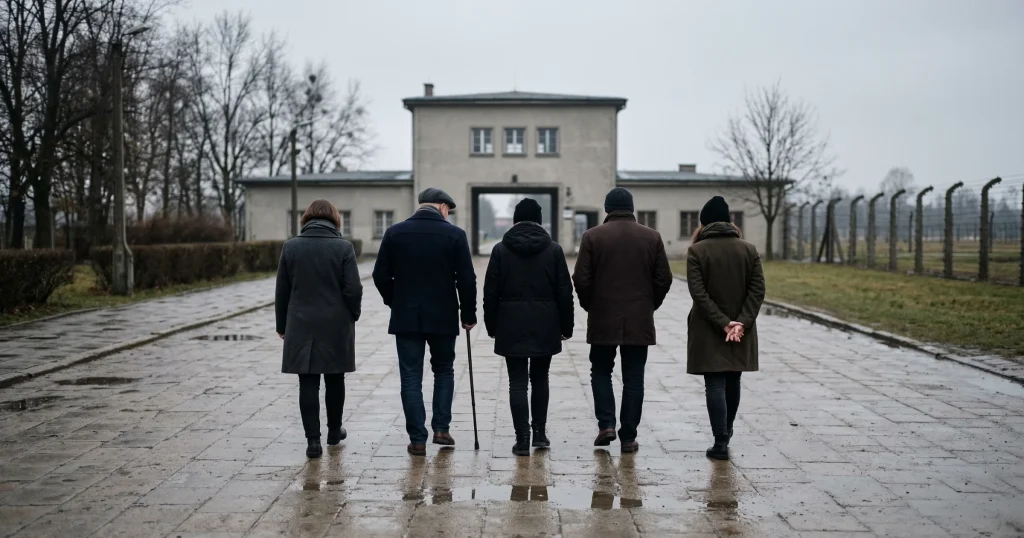
The Auschwitz-Birkenau State Museum is not a conventional museum. It is a cemetery, a crime scene and a place of remembrance operating on an enormous physical scale.
UNESCO World Heritage Site and Official Status
The Auschwitz-Birkenau State Museum carries the full official designation Auschwitz-Birkenau German Nazi Concentration and Extermination Camp (1940–1945), in Oswiecim, southern Poland. UNESCO awarded the inscription in 1979 under criterion (vi) — marking it as a monument to the deliberate genocide of the Jewish people and the deaths of countless others. That decision put the Auschwitz-Birkenau Memorial and Museum in rare company: one of only a handful of sites listed purely for their historical testimony, not for architecture or landscape.
Three main camps and over 40 subcamps once spread across roughly 40 square kilometres. Today, the memorial and museum Auschwitz-Birkenau draws over two million visitors annually — British and Italian travellers frequently make up the largest international groups alongside Poles. A Polish state institution established by act of parliament in 1947 runs the site, making it one of the oldest Holocaust memorials anywhere. Visit.auschwitz.org is the only official platform for guided tour bookings and timed entry.
The Memorial as Cemetery: What That Means for Visitors
Conservation here follows what the museum calls a ‘passive’ approach — historical integrity over visual restoration. Ruins stay as ruins. Crumbling brickwork stays crumbling. The foundations of demolished gas chambers sit exposed to the weather. None of that is neglect. The site is treated as a cemetery where 1.1 million people were murdered, and the slow decay is part of what it preserves.
People who’ve been say no book, documentary or school lesson quite gets you ready for standing there. Birkenau Auschwitz isn’t somewhere you enjoy visiting. It’s somewhere you feel you have to go. That distinction shapes everything — the tone of the educators, the photography rules, the way silence settles over the grounds.
💡 Visitor tip: No amount of prior research — films, books, classroom lessons — fully prepares you for being on site. Travellers across every background say the same thing: Auschwitz-Birkenau isn’t a place you enjoy visiting. It’s a place you feel compelled to visit.
Auschwitz I, II and III: Understanding the Difference Between the Camps
Visitors searching for the difference between Auschwitz and Birkenau are asking the right question. The two names refer to distinct camps with different histories and very different physical layouts.
Auschwitz I: The Stammlager and Its Exhibitions
Auschwitz I — the Stammlager — opened in April 1940 inside former Polish army barracks. It served as the administrative hub of the entire camp system and is where you’ll find the Visitor Service Centre and the permanent exhibitions in the original brick blocks. All guided tours start here. Auschwitz 1 contains Crematorium I, though it’s a partial post-war reconstruction: the SS converted the original building into an air-raid shelter in 1944, and the furnaces and chimney were rebuilt in 1947 using surviving components. A placard on site says so plainly — the Auschwitz 1 gas chamber is both a historical artefact and a reconstruction, and the museum doesn’t try to hide that.
Auschwitz II-Birkenau: The Extermination Centre
Auschwitz II-Birkenau sits 3.5 km from Auschwitz I, in the village of Brzezinka. Construction began in October 1941; the site grew to cover over 175 hectares. This was the primary location of the Holocaust’s industrialised mass murder. The Auschwitz II historical gate — the brick gatehouse the railway runs through — took its current form in 1943. The direct rail line into the camp wasn’t completed until spring 1944, just before the mass deportation of Hungarian Jews began. Put Auschwitz 1 and 2 side by side on a map and the difference in scale is startling — Birkenau’s footprint is many times larger.
Auschwitz III-Monowitz and the Sub-camps
Auschwitz III-Monowitz came into operation in October 1942, supplying forced labour to the IG Farben Buna-Werke synthetic rubber factory — what prisoners called Buna Auschwitz. Little remains for visitors to see today. Auschwitz III, together with over 40 subcamps, formed the broader network that stretched across the region. For most people making the trip, Auschwitz I and Auschwitz II Birkenau are where you’ll spend your time.
💡 Visitor tip: People on Reddit describe the two sites as producing entirely different emotional states: ‘Auschwitz I is where the details are — Birkenau shows you the scale.’ Almost everyone agrees that seeing only one camp leaves the picture incomplete.
What to See at Auschwitz-Birkenau: Layout, the Gate of Death, Gas Chambers and Barracks
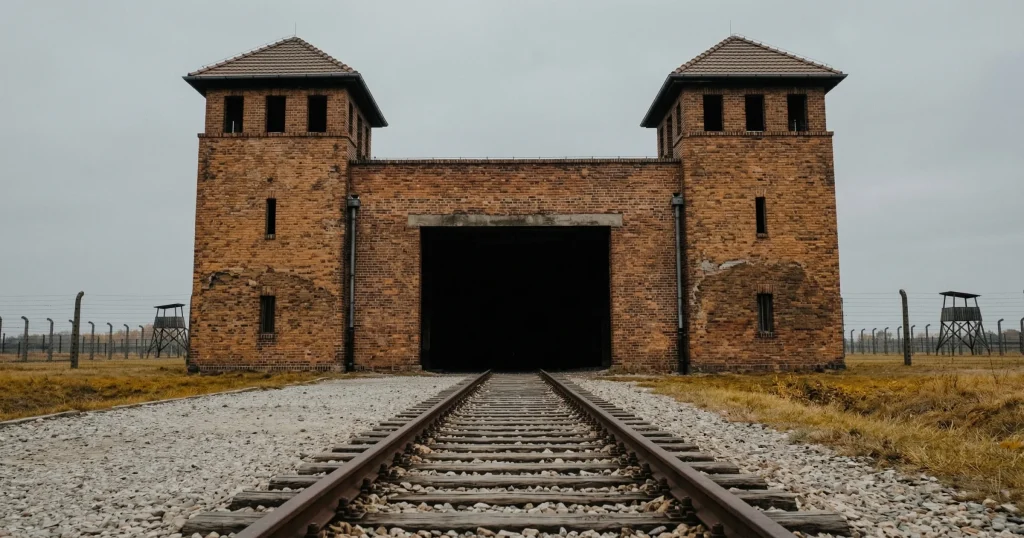
The Auschwitz Birkenau layout spans two sites with very different physical character. Here’s what you’ll find at each.
Key Landmarks at Auschwitz I
- The ‘Arbeit Macht Frei’ gate is a replica — the original was stolen in 2009, recovered 70 hours later, and stored for conservation; the ‘B’ is welded upside down, an act of resistance by prisoner-blacksmith Jan Liwacz.
- Block 4 holds approximately 7 tonnes of human hair — photography is prohibited inside.
- Crematorium I is a partial post-war reconstruction; a placard acknowledges the furnaces were rebuilt in 1947.
- The brick blocks house exhibitions on deportations, living conditions and Auschwitz Birkenau shoes and suitcases.
Key Landmarks at Birkenau (Auschwitz II)
- The Auschwitz Birkenau gate — the Gate of Death — is the brick gatehouse through which the railway runs into the camp.
- Crematoria II, III and V were blown up by the SS in January 1945; their ruins are preserved in situ. Crematorium IV was partially destroyed during the Sonderkommando revolt of October 1944.
- The International Monument between the crematoria ruins hosts commemorative ceremonies including International Holocaust Remembrance Day on 27 January.
- The Auschwitz Birkenau barracks stretch across 175 hectares and are largely open to walk through.
Moving Between the Two Sites
A free shuttle connects Auschwitz to Birkenau every 10–15 minutes. Walking is doable — 3.5 km along the road — but most people take the shuttle. Birkenau alone means 2–3 km on gravel and grass with almost no shade.
💡 Visitor tip: People describe Birkenau as eerily silent — more emotionally devastating than Auschwitz I, even with fewer indoor exhibitions. The shoes and suitcases at Auschwitz I are cited again and again as the single exhibit most likely to break your composure.
Visiting the Auschwitz-Birkenau State Museum: Reviews, Photos and What Visitors Say
Photography for private use is allowed throughout most of the Auschwitz-Birkenau State Museum — no flash, no tripods. Two zones are off-limits: the interior of the hair display room in Block 4 and the basements of Block 11. Drones need specific written permission from the museum director. Anyone hoping to capture an Auschwitz Birkenau aerial view will have to rely on the museum’s own published imagery or licensed stock.
Blocks 8 and 9 at Auschwitz I opened in 2025 with a new exhibition titled ‘Auschwitz – Experiences of Camp Prisoners,’ built around children’s drawings and personal artefacts to put individual human fates at the centre. In Auschwitz-Birkenau State Museum reviews, this exhibition keeps appearing among the most recommended additions to the visit.
Many 2025 visitor accounts mention the frustration of watching others pose for photographs at the railway tracks, the gate, or inside the gas chamber ruins. The museum has stepped up interventions, but it keeps happening. Those who describe the Auschwitz Birkenau visit most positively bring up the same thing: the quality of the official museum educators. Knowledgeable, emotionally intelligent, historically precise — guides are named by visitors as the single most valuable part of the experience. That pattern holds across Google, TripAdvisor and travel forums alike.
💡 Visitor tip: Travellers who leave satisfied almost always mention the museum educators specifically — guides described as knowledgeable, emotionally intelligent and exact with the history. Booking a guided tour rather than going it alone makes a real difference.
Auschwitz-Birkenau Liberation, Survivors and the No-Birds Myth
Auschwitz was liberated on 27 January 1945 by the 322nd Rifle Division of the Soviet 60th Army. Around 7,000 Auschwitz Birkenau survivors were found across Auschwitz I, Birkenau and Monowitz. Before the Soviets arrived, the SS forced roughly 58,000 prisoners on ‘death marches’ westward, blowing up the crematoria and burning records to hide the evidence. That date — 27 January — is now International Holocaust Remembrance Day, observed worldwide.
One question keeps appearing in visitor searches: why do birds not fly over Auschwitz Birkenau? It isn’t true. Birds nest in the ruins of the crematoria. They fly across Birkenau’s fields. The sense of silence comes from what the site does to you, not from anything physical happening around you. Visitors write independently that Birkenau feels ‘eerily quiet,’ that birdsong seems to disappear. That’s how powerful the effect is. Why are there no birds at Auschwitz Birkenau? There are. You just stop noticing them.
💡 Visitor tip: Visitors consistently describe Birkenau as feeling ‘eerily quiet,’ with birdsong seeming to vanish. Jewish visitors describe the train approach to Oswiecim as deeply moving — those same rail lines carried deportees from across Europe.
Opening Hours, Food, Toilets and Hotels Near Auschwitz-Birkenau
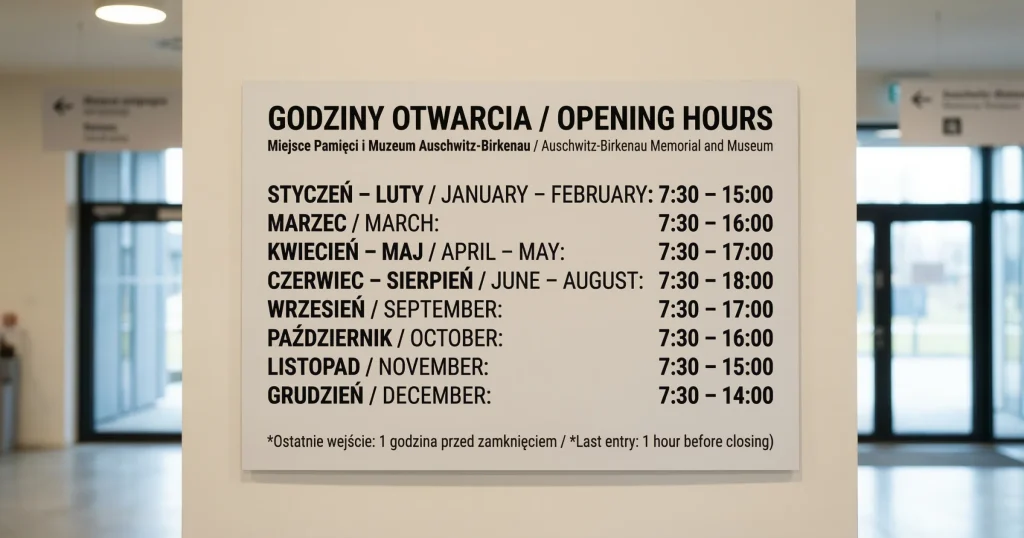
Auschwitz Birkenau opening times, food options and nearby accommodation — the practical details for planning your visit.
Opening Hours by Month
Auschwitz Birkenau opening hours are the same for entry but shift for closing. Both sites open at 7:30 AM daily. You can stay on 90 minutes after the last admitted entry.
| Month | Opening Time | Closing Time |
|---|---|---|
| December | 7:30 AM | 15:00 |
| January, November | 7:30 AM | 16:00 |
| February | 7:30 AM | 17:00 |
| March, October | 7:30 AM | 18:00 |
| April, May, September | 7:30 AM | 19:00 |
| June, July, August | 7:30 AM | 20:30 |
These Auschwitz Birkenau opening times are for last entry — the grounds stay open for 90 minutes after that.
Food, Drinks and Toilets on Site
There’s no food at Auschwitz Birkenau inside the grounds. Can you buy food at Auschwitz Birkenau? Only at the Visitor Service Centre cafeteria (Auschwitz I) or a kiosk near the Birkenau car park. Is there a cafe at Auschwitz-Birkenau? The Visitor Service Centre has one. You’re allowed to bring a small water bottle. Toilets are at the entrances only — there aren’t any along the route. Use the 15–20 minute shuttle break between sites.
Hotels Near Auschwitz-Birkenau
Hotels near Auschwitz-Birkenau cluster in Oswiecim, 2 km away, at 200–400 PLN (~£39–£78 / ~€47–€93) per night. Most visitors day-trip from Krakow (70 km, 75–90 minutes). Luggage lockers cost 5–10 PLN (~£1–£2 / ~€1.20–€2.30); bags over 35 x 25 x 15 cm must be stored.
⚠ Watch out: Many drivers park at Birkenau and assume that’s fine. All guided tours begin at Auschwitz I. Park there first — parking at Birkenau means a shuttle back before your tour can even start.
💡 Visitor tip: Bring water, snacks and tissues. Birkenau is wide open — no cover, no shade. Sun protection in summer and warm layers in winter are the two things visitors most often say they wished they’d had.
Frequently Asked Questions
Can you visit Auschwitz and Birkenau on the same visit?
Yes — both sites are part of the same memorial complex and are meant to be seen together. A free shuttle runs between Auschwitz I and Birkenau every 10–15 minutes during peak hours, taking roughly 5 minutes each way. Standard guided tours cover both, starting at Auschwitz I before transferring to Birkenau.
What is the difference between Auschwitz I and Auschwitz-Birkenau (Auschwitz II)?
Auschwitz I (the Stammlager) opened in 1940 as the administrative centre and holds permanent exhibitions in brick blocks, including Crematorium I. Auschwitz II-Birkenau, built from 1941 across 175 hectares, was the primary site of industrialised mass murder. Auschwitz I is where the details are. Birkenau shows you the scale.
How far is Birkenau from Auschwitz I?
The two sites are 3.5 km apart. A free shuttle connects them every 10–15 minutes during visiting hours, with a journey time of around 5 minutes. Walking is possible along a pavement beside the road — that takes about 40–45 minutes.
Can you walk from Auschwitz to Birkenau?
Yes. The 3.5 km route runs along a pavement beside the road and takes roughly 40–45 minutes on foot. Most people take the free shuttle instead — especially after several hours of walking at Auschwitz I or in poor weather.
Is there a free shuttle bus between Auschwitz I and Birkenau?
Yes. The museum runs a free shuttle between the two sites every 10–15 minutes during peak visiting hours. The journey’s about 5 minutes. It departs from outside the Visitor Service Centre at Auschwitz I and from the car park area at Birkenau.
How long does it take to see both Auschwitz I and Birkenau?
A standard guided tour of both sites takes around 3.5 hours. Going independently typically means 4–5 hours if you want to take in the main exhibitions at Auschwitz I and walk the full grounds at Birkenau. Birkenau alone calls for 2–3 km of walking on gravel and grass.
Is it free to enter Auschwitz-Birkenau?
Entry to the grounds of both sites is free. Guided tours with a museum educator cost 150 PLN (~£29 / ~€35) per adult and must be booked at visit.auschwitz.org. During peak hours (10:00–15:00 in high season), entry to Auschwitz I may only be possible with a guided tour booking.
Does the standard Auschwitz guided tour include Birkenau?
Yes. The standard guided tour covers both Auschwitz I and Auschwitz II-Birkenau. It starts at the Visitor Service Centre at Auschwitz I, then transfers to Birkenau by shuttle bus. The full tour runs about 3.5 hours.
What are the opening hours at Auschwitz-Birkenau?
Both sites open at 7:30 AM every day of the year. Closing time shifts by month: 15:00 in December, 16:00 in January and November, 17:00 in February, 18:00 in March and October, 19:00 in April, May and September, and 20:30 in June, July and August. You can stay on site for 90 minutes after the last admitted entry.
What should you expect when visiting Auschwitz-Birkenau for the first time?
Auschwitz I has indoor exhibitions — personal belongings, documents, photographs — in the original brick blocks. Birkenau is open-air: 175 hectares of ruins, barracks and crematoria foundations. The visit is physically demanding (2–3 km of uneven ground at Birkenau) and emotionally confronting. Books and films don’t fully prepare most people for the reality of standing there.
Can you take photos at Auschwitz-Birkenau?
Photography for private use is allowed across most of the site — no flash, no tripods. Two areas are off-limits: the hair display room in Block 4 and the basements of Block 11. Drones aren’t permitted without specific written permission from the museum director. The museum asks visitors to photograph respectfully and avoid posed or casual shots.
Is Auschwitz-Birkenau suitable for children?
The museum recommends children under 14 don’t visit. The exhibitions include graphic images and distressing artefacts — human hair, personal belongings of victims. Parents bringing older teenagers should prepare them beforehand for what they’ll encounter and allow time to process the emotional weight of the experience.
What is the best time of year to visit Auschwitz-Birkenau?
Spring (April–May) and early autumn (September–October) offer mild weather and smaller crowds than the summer peak. Winter means shorter hours but far fewer visitors. Birkenau is almost entirely outdoors with minimal shade, so summer heat and winter cold both call for preparation. Booking 6–10 weeks ahead is worth doing for any season.
Is there a café or food available at Auschwitz-Birkenau?
There’s no food or drink inside the historical grounds. A cafeteria runs in the Visitor Service Centre at Auschwitz I, and a small kiosk sits near the Birkenau car park. You’re allowed to bring a small bottle of water. Both on-site options are described by visitors as overpriced.
Why do birds not fly over Auschwitz-Birkenau?
They do. It’s a myth. Birds nest in the crematoria ruins and fly across Birkenau’s fields regularly. The sense of silence is a psychological effect — the site hits visitors so hard that the sounds around them stop registering. Multiple independent accounts describe Birkenau as ‘eerily quiet,’ which shows how powerful that effect is.
